


Une fenêtre basculante pivote à 180 degrés sur un axe horizontal placé au milieu du vitrage. Elle facilite l’aération et le nettoyage, mais son intérêt dépend du matériau, du vitrage et de la qualité de la pose.
Le grand pivot, quand l’air prend deux chemins
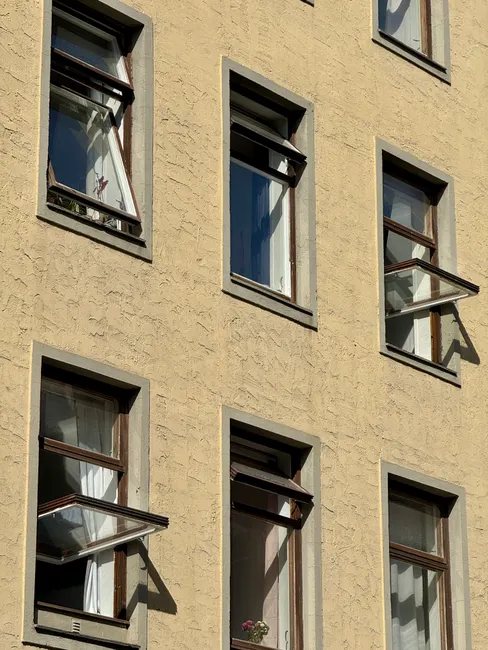
À la différence d’une fenêtre abattante, qui s’entrouvre seulement par le haut, la fenêtre basculante tourne sur son axe horizontal. Sa partie haute et sa partie basse s’écartent alors du dormant, ce qui crée deux passages d’air.
Cette configuration permet à l’air chaud de s’évacuer par le haut et à l’air plus frais d’entrer par le bas. L’ouverture peut rester partielle, ce qui convient à une cuisine, une salle de bains ou une pièce sous toiture.
La géométrie de l’ouvrant peut aussi limiter l’entrée de pluie pendant l’aération lorsqu’elle est associée à un raccord d’étanchéité adapté. Le résultat dépend toutefois de la fenêtre, de son raccord et de sa mise en oeuvre.
Le pivot est utile parce qu’il combine ventilation réglable et ouverture complète.
Combles et coins serrés, le bon angle

La fenêtre basculante trouve naturellement sa place dans les combles aménagés, les pièces exiguës et certains immeubles. Elle demande moins d’espace de débattement devant l’ouverture qu’un vantail classique, ce qui évite de condamner un passage ou un meuble.
Elle a longtemps été associée aux fenêtres de toit. Son usage s’est ensuite étendu à d’autres configurations, notamment lorsque l’on cherche à aérer sans ouvrir largement la pièce. La fiche technique ne suffit pas à elle seule : il faut encore vérifier l’espace disponible autour de l’ouvrant et l’accès à la poignée.
Pour une fenêtre de toit, le pivot complet simplifie le nettoyage de la face extérieure. On évite ainsi la séance d’acrobatie sur l’escabeau, ce qui n’est pas franchement un détail.
PVC, bois ou aluminium, le cadre fait loi
Le PVC est apprécié pour son prix, son entretien limité et son niveau d’isolation. Le bois s’accorde avec les intérieurs traditionnels, mais il doit être traité et entretenu avec soin. L’aluminium offre une bonne longévité et des profilés fins, à condition de choisir un modèle dont les performances thermiques correspondent au projet.
Les structures mixtes associent deux matériaux, par exemple le bois et l’aluminium ou le PVC et l’aluminium. Elles permettent de différencier l’aspect intérieur et extérieur, mais leur prix varie avec la composition et la finition.
Le matériau ne se choisit donc pas sur l’apparence seule : prix, entretien et isolation doivent être lus ensemble.
Le prix ne tient pas sur un axe

Le prix d’une fenêtre basculante varie selon le matériau, la finition, le vitrage, la motorisation et la pose. Un montant affiché pour l’ouvrant ne décrit pas nécessairement l’ensemble du chantier. Il faut comparer des offres qui couvrent les mêmes prestations.
Une offre claire doit au minimum distinguer la fenêtre, le vitrageles accessoires, la motorisation éventuelle, le raccord d’étanchéité et la pose. Sans ce découpage, deux montants peuvent sembler comparables alors qu’ils ne comprennent pas la même chose. Ça sonne vite creux, ce devis qui aligne un prix sans détailler le contenu.
La motorisation ajoute une commande pilotée pour organiser l’aération. Elle peut être intéressante lorsque l’on veut régler l’ouverture sans manipuler directement l’ouvrant, mais elle ne dispense ni d’un choix adapté ni d’une pose correcte.
Vitrage et motorisation, le duo à régler

Le vitrage participe au niveau d’isolation, au prix et à l’aspect de la fenêtre. Il doit être comparé avec le matériau du profilé et avec l’usage de la pièce. Dans une cuisine ou une salle de bains, la possibilité de moduler l’ouverture compte autant que la ligne technique du vitrage.
La motorisation apporte une commande plus élaborée de l’aération. Elle ne transforme pas une fenêtre mal dimensionnée en solution universelle : l’ouvrant, le profilé, le vitrage et le raccord doivent rester cohérents.
Pour comparer les offres, on peut suivre cette vérification :
- identifier le matériau et la finition de la fenêtre;
- faire préciser le vitrage et son niveau d’isolation;
- séparer le prix de la motorisation et des accessoires;
- vérifier la présence du raccord d’étanchéité et de la pose.
Pose étanche, pas de tour de magie

La pose ne se résume pas à mettre l’ouvrant dans son emplacement. Le raccord d’étanchéité doit être adapté, notamment pour une fenêtre de toit, afin de détourner l’eau autour de la menuiserie.
Pour éviter les mauvaises surprises, demandez un devis à un installateur compétent et qualifié. La comparaison doit porter sur un ensemble identique : même matériau, même vitrage, mêmes accessoires et même niveau de finition. Sinon, le budget bascule d’une offre à l’autre sans que l’on sache vraiment pourquoi.
Une fenêtre performante ne rattrape pas une pose qui laisse l’eau trouver son chemin.
Nettoyage en rotation, entretien sans acrobatie

Le pivot complet facilite le nettoyage de la face extérieure, surtout lorsque la fenêtre est installée dans un toit. Cette fonction réduit les interventions difficiles, à condition de respecter le mouvement prévu par la menuiserie et de ne pas forcer l’ouvrant.
Dans une pièce humide, l’ouverture réglable accélère le renouvellement de l’air. Elle ne remplace pas pour autant une ventilation adaptée à la pièce. La fenêtre aide à aérer; elle ne règle pas à elle seule tous les problèmes d’humidité.
Le bon pivot, c’est celui qui ventile, se nettoie et reste étanche sans transformer chaque ouverture en chantier. Et si le devis commence déjà à tourner, mieux vaut regarder ce qu’il contient avant de faire basculer la commande.
Sources et références scientifiques
- Effects of shoulder rotation and table tilt maneuvers on the lumbar and thoracic paramedian acoustic window in older adults: a quasi-experimental study – PMC. Brazilian journal of anesthesiology (Elsevier). DOI: 10.1016/j.bjane.2026.844769 · PMID: 42229632.
- 1.Barbosa F.T., Jucá M.J., Castro AA. Neuroaxis Block Compared to General Anesthesia for Revascularization of the Lower Limbs in the Elderly. A Systematic Review with Metanalyzis of Randomized Clinical Studies. Braz J Anesthesiol. 2009;59:234-243. doi: 10.1590/s0034-70942009000200012. [DOI] [PubMed] [Google Scholar]. doi:10.1590/s0034-70942009000200012.
- 2.Nordquist D., Halaszynski TM. Perioperative multimodal anesthesia using regional techniques in the aging surgical patient. Pain Res Treat. 2014;2014:1-10. doi: 10.1155/2014/902174. [DOI] [PMC free article] [PubMed] [Google Scholar]. doi:10.1155/2014/902174.
- 3.Fechine BRA. O processo de envelhecimento: as principais alterações que acontecem com o idoso com o passar dos anos. InterSciencePlace. 2012;1:106-132. [Google Scholar].
- 4.Albuquerque M., Mattos S., Nunes R. 1st ed. Rio de Janeiro: Sociedade Brasileira de Anestesiologia; 2018. Educação Continuada em Anestesiologia. [Google Scholar].
- 5.Atallah M.M., Demian A.D., Shorrab A.A., et al. Development of a difficulty score for spinal anaesthesia. Br J Anaesth. 2004;92:354-360. doi: 10.1093/bja/aeh073. [DOI] [PubMed] [Google Scholar]. doi:10.1093/bja/aeh073.
- 6.Duits F.H., Martinez-Lage P., Paquet C., et al. Performance and complications of lumbar puncture in memory clinics: Results of the multicenter lumbar puncture feasibility study. Alzheimers Dement. 2016;12:154-163. doi: 10.1016/j.jalz.2015.08.003. [DOI] [PubMed] [Google Scholar]. doi:10.1016/j.jalz.2015.08.003.
- 7.Poots C., Chin KJ. Strategies for successful lumbar neuraxial anesthesia and analgesia in patients with challenging anatomy. BJA Educ. 2024;24:46-56. doi: 10.1016/j.bjae.2023.10.006. [DOI] [PMC free article] [PubMed] [Google Scholar]. doi:10.1016/j.bjae.2023.10.006.
- 8.Perlas A., Chaparro L.E., Chin KJ. Lumbar neuraxial ultrasound for spinal and epidural anesthesia: A systematic review and meta-analyzis. Reg Anesth Pain Med. 2016;41:251-260. doi: 10.1097/AAP.0000000000000184. [DOI] [PubMed] [Google Scholar]. doi:10.1097/AAP.0000000000000184.
- in K.J., Ramlogan R., Arzola C., et al. The Utility of Ultrasound Imaging in Predicting Ease of Performance of Spinal Anesthesia in an Orthopedic Patient Population. Reg Anesth Pain Med. 2013;38:34-38. doi: 10.1097/AAP.0b013e3182734927. [DOI] [PubMed] [Google Scholar]. doi:10.1097/AAP.0b013e3182734927.
- in K.J., Perlas A., Chan V., et al. Ultrasound Imaging Facilitates Spinal Anesthesia in Adults with Difficult Surface Anatomic Landmarks. Anesthesiology. 2011;115:94-101. doi: 10.1097/ALN.0b013e31821a8ad4. [DOI] [PubMed] [Google Scholar]. doi:10.1097/ALN.0b013e31821a8ad4.
- 11.Weed J.T., Taenzer A.H., Finkel K.J., et al. Evaluation of pre-procedure ultrasound examination as a screening tool for difficult spinal anesthesia. Anaesthesia. 2011;66:925-930. doi: 10.1111/j.1365-2044.2011.06834.x. [DOI] [PubMed] [Google Scholar]. doi:10.1111/j.1365-2044.2011.06834.x.
- 12.Ramsay N., Walker J., Tang R., et al. Flexion-rotation manoeuvre increases dimension of the acoustic target window for paramedian thoracic epidural access. Br J Anaesth. 2014;112:556-562. doi: 10.1093/bja/aet385. [DOI] [PubMed] [Google Scholar]. doi:10.1093/bja/aet385.
- Orthostatic Stress and Baroreflex Sensitivity: A Window into Autonomic Dysfunction in Lone Paroxysmal Atrial Fibrillation – PMC. Journal of clinical medicine. DOI: 10.3390/jcm12185857 · PMID: 37762798.
- 1.Wolf P.A., Benjamin E.J., Belanger A.J., Kannel W.B., Levy D., D’Agostino R.B. Secular trends in the prevalence of atrial fibrillation: The Framingham Study. Am. Heart J. 1996;131:790-795. doi: 10.1016/S0002-8703(96)90288-4. [DOI] [PubMed] [Google Scholar]. doi:10.1016/S0002-8703(96)90288-4.
- ugh S.S., Blackshear J.L., Shen W.-K., Hammill S.C., Gersh B.J. Epidemiology and natural history of atrial fibrillation: Clinical implications. J. Am. Coll. Cardiol. 2001;37:371-378. doi: 10.1016/S0735-1097(00)01107-4. [DOI] [PubMed] [Google Scholar]. doi:10.1016/S0735-1097(00)01107-4.
- 3.Thrall G., Lane D., Carroll D., Lip G.Y. Quality of Life in Patients with Atrial Fibrillation: A Systematic Review. Am. J. Med. 2006;119:448.e1-448.e19. doi: 10.1016/j.amjmed.2005.10.057. [DOI] [PubMed] [Google Scholar]. doi:10.1016/j.amjmed.2005.10.057.
- 4.Ball J., Carrington M.J., McMurray J.J., Stewart S. Atrial fibrillation: Profile and burden of an evolving epidemic in the 21st century. Int. J. Cardiol. 2013;167:1807-1824. doi: 10.1016/j.ijcard.2012.12.093. [DOI] [PubMed] [Google Scholar]. doi:10.1016/j.ijcard.2012.12.093.
- ugh S.S., Havmoeller R., Narayanan K., Singh D., Rienstra M., Benjamin E.J., Gillum R.F., Kim Y.-H., Zheng Z.J., Murray C.J. Worldwide epidemiology of atrial fibrillation: A Global Burden of Disease 2010 Study. Circulation. 2014;129:837-847. doi: 10.1161/CIRCULATIONAHA.113.005119. [DOI] [PMC free article] [PubMed] [Google Scholar]. doi:10.1161/CIRCULATIONAHA.113.005119.
- 6.January C.T., Wann L.S., Alpert J.S., Calkins H., Cigarroa J.E., Cleveland J.C., Jr., Conti J.B., Ellinor P.T., Ezekowitz M.D., Field M.E. AHA/ACC/HRS guideline for the management of patients with atrial fibrillation. J. Am. Coll. Cardiol. 2014;64:e1-e76. doi: 10.1016/j.jacc.2014.03.022. [DOI] [PubMed] [Google Scholar]. doi:10.1016/j.jacc.2014.03.022.
- 7.Colilla S., Crow A., Petkun W., Singer D.E., Simon T., Liu X. Estimates of Current and Future Incidence and Prevalence of Atrial Fibrillation in the U.S. Adult Population. Am. J. Cardiol. 2013;112:1142-1147. doi: 10.1016/j.amjcard.2013.05.063. [DOI] [PubMed] [Google Scholar]. doi:10.1016/j.amjcard.2013.05.063.
- 8.Krijthe B.P., Kunst A., Benjamin E.J., Lip G.Y., Franco O.H., Hofman A., Witteman J.C., Stricker B.H., Heeringa J. Projections on the number of individuals with atrial fibrillation in the European Union, from 2000 to 2060. Eur. Heart J. 2013;34:2746-2751. doi: 10.1093/eurheartj/eht280. [DOI] [PMC free article] [PubMed] [Google Scholar]. doi:10.1093/eurheartj/eht280.
- 9.Hindricks G., Potpara T., Dagres N., Arbelo E., Bax J.J., Blomström-Lundqvist C., Boriani G., Castella M., Dan G.A., Dilaveris P.E., et al. 2020 ESC Guidelines for the diagnosis and management of atrial fibrillation developed in collaboration with the European Association for Cardio-Thoracic Surgery (EACTS) The Task Force for the diagnosis and management of atrial fibrillation of the European Society of Cardiology (ESC) Developed with the special contribution of the European Heart Rhythm Assoc. doi:10.1093/eurheartj/ehaa612.
- 10.January C.T., Wann L.S., Calkins H., Chen L.Y., Cigarroa J.E., Cleveland J.C., Jr., Ellinor P.T., Ezekowitz M.D., Field M.E., Furie K.L., et al. 2019 AHA/ACC/HRS focused update of the 2014 AHA/ACC/HRS guideline for the management of patients with atrial fibrillation: A report of the American College of Cardiology/American Heart Association Task Force on Clinical Practice Guidelines and the Heart Rhythm Society in collaboration with the Society of Thoracic Surgeons. Circulation. 2019;140:e125-. doi:10.1161/CIR.0000000000000665.
- en P.S., Chen L.S., Fishbein M.C., Lin S.F., Nattel S. Role of the autonomic nervous system in atrial fibrillation: Pathophysiology and therapy. Circ. Res. 2014;114:1500-1515. doi: 10.1161/CIRCRESAHA.114.303772. [DOI] [PMC free article] [PubMed] [Google Scholar]. doi:10.1161/CIRCRESAHA.114.303772.
- 12.Haïssaguerre M., Jaïs P., Shah D.C., Takahashi A., Hocini M., Quiniou G., Garrigue S., Le Mouroux A., Le Métayer P., Clémenty J. Spontaneous Initiation of Atrial Fibrillation by Ectopic Beats Originating in the Pulmonary Veins. N. Engl. J. Med. 1998;339:659-666. doi: 10.1056/NEJM199809033391003. [DOI] [PubMed] [Google Scholar]. doi:10.1056/NEJM199809033391003.
- A physical-numerical approach to predicting tension-induced rock mass collapse using reciprocal tilt rate – PMC. Scientific reports. DOI: 10.1038/s41598-026-46251-0 · PMID: 42143103.
- en, H. K. & Tang, H. M. Classification and identify of perilous rock in the area of the Three Gorges Reservior. Chin. J. Geol. Hazard. Control. 16, 53-57 (2005). [Google Scholar].
- 2.Atkinson, B. K. Subcritical crack growth in geological materials. J. Geophys. Res.: Solid Earth. 89, 4077-4114 (1984). [Google Scholar].
- 3.He, Z. Study on instability prediction model of tension-splitting rockmass on slopes. PhD/Master’s thesis, University of Science and Technology Beijing (2024). 10.26945/d.cnki.gbjku.2023.000273. doi:10.26945/d.cnki.gbjku.2023.000273.
- 4.Braathen, A., Blikra, L. H., Berg, S. S. & Karlsen, F. Rock-slope failures in Norway; type, geometry, deformation mechanisms and stability. Norw. J. Geol.84, 67-88 (2004). [Google Scholar].
- 5.Diederichs, M. S. Manuel Rocha medal recipient rock fracture and collapse under low confinement conditions. Rock Mech. Rock Eng.36, 339-381 (2003). [Google Scholar].
- landria, N., Úcar, R., Corredor, A. & Hassani, F. Safety factor on rock slopes with tensile cracks using numerical and limit equilibrium models. Geotech. Geol. Eng.39, 2287-2300 (2021). [Google Scholar].
- ng, Z., Zhang, X., Wang, Z., Min, J. & Wei, J. Analysis of fracture toughness deterioration and instability model of dangerous rock masses under freeze-thaw cycles. Theoret. Appl. Fract. Mech.131, 104398 (2024). [Google Scholar].
- 8.Ren, Q., Jin, H., Ren, X. & Zhang, X. Dynamic response and time-frequency characteristic of dangerous rocks under the combined action of rock cavity weathering and earthquake. Adv. Civ. Eng.2021, 6626916 (2021)..
- 9.Tian, W., Chen, X., Huang, J. & Chen, R. A preconditioning method with auxiliary crack tip subproblems for dynamic crack propagation based on XFEM. Comput. Methods Appl. Mech. Eng.412, 116105 (2023). [Google Scholar].
- 10.Xie, B. et al. Experimentally validated macro-mesoscopic simulation study on the fatigue short crack initiation and propagation in polycrystalline structure utilizing CP-XFEM. Eng. Fract. Mech.319, 110995 (2025). [Google Scholar].
- en, Z., Dai, Y. & Liu, Y. Structural fatigue crack propagation simulation and life prediction based on improved XFEM-VCCT. Eng. Fract. Mech.310, 110519 (2024). [Google Scholar].
- 12.Kou, L., Wang, Y., Wen, X., He, H. & Xiong, Z. Numerical analysis of fracture and crack propagation in rock materials based on peridynamics. Comp. Part. Mech.12, 3881-3897 (2025). [Google Scholar].
- Graphoepitaxial Control of Lamellar Block Copolymer Alignment in Wide Trenches: Effects of Trench Width and Sidewall Tilt – PMC. Polymers. DOI: 10.3390/polym18050557 · PMID: 41829254.
- 1.Ji S., Wan L., Liu C.-C., Nealey P.F. Directed self-assembly of block copolymers on chemical patterns: A platform for nanofabrication. Prog. Polym. Sci. 2016;54-55:76-127. doi: 10.1016/j.progpolymsci.2015.10.006. [DOI] [Google Scholar]. doi:10.1016/j.progpolymsci.2015.10.006.
- eng X., Liang D., Jiang M., Sha Y., Liu X., Liu J., Cao Q., Shi J. Review of Directed Self-Assembly Material, Processing, and Application in Advanced Lithography and Patterning. Micromachines. 2025;16:667. doi: 10.3390/mi16060667. [DOI] [PMC free article] [PubMed] [Google Scholar]. doi:10.3390/mi16060667.
- 3.Cummins C., Lundy R., Walsh J.J., Ponsinet V., Fleury G., Morris M.A. Enabling future nanomanufacturing through block copolymer self-assembly: A review. Nano Today. 2020;35:100936. doi: 10.1016/j.nantod.2020.100936. [DOI] [Google Scholar]. doi:10.1016/j.nantod.2020.100936.
- 4.Nicaise S.M., Tavakkoli S.M., Berggren K.K. Self-assembly of block copolymers by graphoepitaxy. In: Gronheid R., Nealey P., editors. Directed Self-Assembly of Block Co-Polymers for Nano-Manufacturing. Elsevier; Amsterdam, The Netherlands: 2015. pp. 199-232. [Google Scholar].
- 5.Pinto-Gómez C., Pérez-Murano F., Bausells J., Villanueva L.G., Fernández-Regúlez M. Directed Self-Assembly of Block Copolymers for the Fabrication of Functional Devices. Polymers. 2020;12:2432. doi: 10.3390/polym12102432. [DOI] [PMC free article] [PubMed] [Google Scholar]. doi:10.3390/polym12102432.
- 6.Kim M., Han E., Sweat D.P., Gopalan P. Interplay of Surface Chemical Composition and Film Thickness on Graphoepitaxial Assembly of Asymmetric Block Copolymers. Soft Matter. 2013;9:6135-6141. doi: 10.1039/c3sm50307k. [DOI] [Google Scholar]. doi:10.1039/c3sm50307k.
- 7.Wu Z., Luo J., Li L., Dong Q., Zhang X., Li Z., Liu Y., Ji S., Li W., Zhang Y., et al. Manipulating the processing window of directed self-assembly in contact hole shrinking with binary block copolymer/homopolymer blending. iScience. 2024;27:109425. doi: 10.1016/j.isci.2024.109425. [DOI] [PMC free article] [PubMed] [Google Scholar]. doi:10.1016/j.isci.2024.109425.
- 8.Zhan J., Shang C., Niu M., Luo J., Gao S., Wu Z., Niu S., Xu Y., Zhang X., Li Z. An acid-cleavable lamellar block copolymer for sub-30 nm line-spacing patterning via graphoepitaxial DSA and direct wet etching. Polymers. 2025;17:2435. doi: 10.3390/polym17182435. [DOI] [PMC free article] [PubMed] [Google Scholar]. doi:10.3390/polym17182435.
- 9.Ghoshal T., Senthamaraikannan R., Shaw M.T., Lundy R., Selkirk A., Morris M.A. Fabrication of graphoepitaxial gate-all-around Si circuitry patterned nanowire arrays using block copolymer assisted hard mask approach. ACS Nano. 2021;15:9550-9558. doi: 10.1021/acsnano.0c09232. [DOI] [PMC free article] [PubMed] [Google Scholar]. doi:10.1021/acsnano.0c09232.
- 10.Maekawa S., Seshimo T., Dazai T., Sato K., Hatakeyama-Sato K., Nabae Y., Hayakawa T. Chemically tailored block copolymers for highly reliable sub-10-nm patterns by directed self-assembly. Nat. Commun. 2024;15:5671. doi: 10.1038/s41467-024-49839-0. [DOI] [PMC free article] [PubMed] [Google Scholar]. doi:10.1038/s41467-024-49839-0.
- 11.Michman E., Oded M., Shenhar R. Non-bulk morphologies of extremely thin block copolymer films cast on topographically defined substrates featuring deep trenches: The importance of lateral confinement. Polymers. 2023;15:1035. doi: 10.3390/polym15041035. [DOI] [PMC free article] [PubMed] [Google Scholar]. doi:10.3390/polym15041035.
- 12.Park S.-M., Stoykovich M.P., Ruiz R., Zhang Y., Black C.T., Nealey P. Directed Assembly of Lamellae-Forming Block Copolymers by Using Chemically and Topographically Patterned Substrates. Adv. Mater. 2007;19:607-611. doi: 10.1002/adma.200601421. [DOI] [Google Scholar]. doi:10.1002/adma.200601421.
- La fenêtre basculante | Quelle Énergie.
Related Posts

Post a Comment